About TEK8
Traditional Ecological Knowledge, 8 Elements. An invitation toward holistic education rooted in gardens, games, music, and community.
What TEK8 Is
TEK8 is a learning framework that maps eight dimensions of human experience to eight elements, eight dice, and eight forms of capital. It structures daily practice through the Crystal Cycle — a 10-step rhythm of intention, creativity, inquiry, rest, play, reflection, and gratitude.
The attainment system — Roll / Maximum — means every domain of learning has equal value. A 3 on a D4 (75%) matters as much as a 15 on a D20 (75%). No petal dominates. No die is "best." Growth is always measured against the self, not against others.
The framework draws on Ethan Roland and Gregory Landua's Regenerative Enterprise (eight capitals), Dr. Peggy Swarbrick's Eight Dimensions of Wellness (SAMHSA model), the International Baccalaureate Theory of Knowledge areas, and the Bhagavad Gita 3.42 hierarchy (senses, mind, intelligence, wealth).
TEK8 and Traditional Ecological Knowledge
The "TEK" in TEK8 stands for Traditional Ecological Knowledge. This term was coined and popularized by Winona LaDuke (Anishinaabe) in her 1994 paper in the Colorado Journal of International Environmental Law and Policy. LaDuke defined TEK as the body of knowledge that indigenous peoples maintain about their ecosystems — relational, place-based, communal, and intergenerational.
"Indigenous knowledge is not a data set to be extracted. It is a living relationship between peoples and their lands, waters, and relatives — human and more-than-human."
— Summarizing the work of LaDuke, Cajete, Kimmerer, Berkes, and Smith
TEK8 is an invitation toward TEK, not a claim to contain it. No framework, curriculum, or game system can encapsulate the depth, specificity, and relational nature of indigenous knowledge systems. TEK is not a curriculum standard. It is a way of being in relationship with the living world that can only be learned through sustained, place-based, community-embedded practice.
What TEK8 does is create structural space for TEK to be encountered, respected, and learned from — within an educational framework that refuses to rank knowledge domains hierarchically. The eight-petal structure ensures that indigenous knowledge (Earth/D6) holds equal weight with scientific knowledge (Air/D8), artistic knowledge (Ether/D12), and every other way of knowing.
Key scholars whose work informs this relationship: Winona LaDuke (All Our Relations), Gregory Cajete (Native Science), Robin Wall Kimmerer (Braiding Sweetgrass), Fikret Berkes (Sacred Ecology), and Linda Tuhiwai Smith (Decolonizing Methodologies).
CARE Principles for Indigenous Data Sovereignty
TEK8 is committed to the CARE Principles for Indigenous Data Governance, developed by the Global Indigenous Data Alliance (GIDA). These principles complement the FAIR data principles (Findable, Accessible, Interoperable, Reusable) by centering the rights and interests of indigenous peoples.
Collective Benefit
Data ecosystems shall be designed and function in ways that enable indigenous peoples to derive benefit from the data. Any use of TEK or indigenous knowledge within TEK8 programming must generate reciprocal benefit for the source communities.
Authority to Control
Indigenous peoples' rights and interests in indigenous data must be recognized and their authority to control such data respected. Community partners maintain full authority over how their knowledge is represented, shared, and used within TEK8 contexts.
Responsibility
Those working with indigenous data have a responsibility to share how those data are used to support indigenous peoples' self-determination and collective benefit. TEK8 commits to transparency in how indigenous knowledge influences the framework.
Ethics
Indigenous peoples' rights and wellbeing should be the primary concern at all stages of the data life cycle. The ethical use of indigenous knowledge requires ongoing relationship, not one-time consultation.
For more on the CARE Principles, see the Global Indigenous Data Alliance.
Land Acknowledgment
TEK8 is developed on the traditional territories of the Duwamish, Suquamish, Muckleshoot, Tulalip, Puyallup, and other Coast Salish peoples — nations that have stewarded these lands and waters since time immemorial and continue to do so today.
A land acknowledgment is not a statement. It is a commitment. For TEK8, this commitment means:
- Ensuring that benefits from TEK8 programming flow back to indigenous communities
- Centering Washington State's Since Time Immemorial curriculum in our educational framework
- Supporting tribal sovereignty in education through the framework's self-determination architecture
- Maintaining that indigenous knowledge holds equal standing with all other knowledge domains in TEK8 — structurally, not rhetorically
We recognize that land acknowledgments without action are performative. Our commitment is demonstrated through the structure of the framework itself: an education system where no single way of knowing dominates, where cultural continuity is the first form of capital, and where the goal is self-determination at every level.
Where It Started
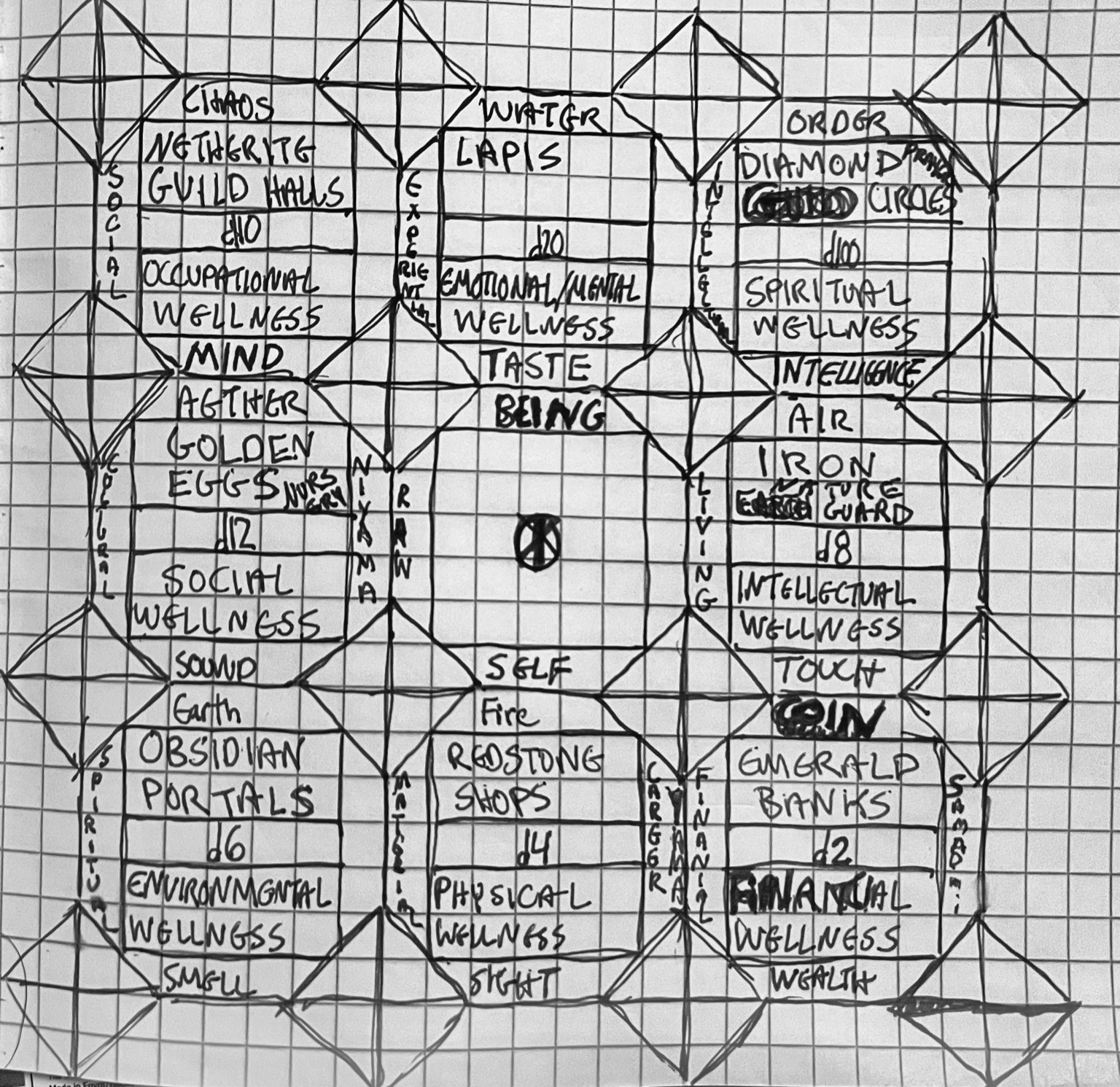
The original TEK8 Learning Lotus — hand-drawn on graph paper, mapping 8 guilds to 8 dimensions of human development
TEK8 began as a sketch on graph paper — mapping the eight dimensions of human experience onto eight dice, eight elements, and eight guilds. The question was simple: what if every way of knowing had equal weight? What if a garden mattered as much as a test score?
The People
Cody Lestelle — Founder and lead facilitator. 7 years teaching in Seattle Public Schools. 30+ years tabletop RPG design and facilitation. Decades of organic farming and garden-based education. Creator of the TEK8 Learning Lotus, CrySword SAGA, and the Crystal Cycle.
TEK8 is developed through Peoples Arcade, TimeKnot Games, and Quillverse Education — a family of organizations dedicated to game-based learning, community development, and cultural production.
The 7ABCs Local-Global Studies Cooperative is the flagship community where the Crystal Cycle comes alive. Join us to learn more.
Get in Touch
For partnership inquiries, research collaboration, or questions about TEK8:
Connect on Skool